PROGRAMS
B.Tech. EE - Electrical Engineering
-
Faculty Engineering
-
Department Electrical Engineering
-
Duration 8 Semesters (4 Years)
Eligibility Criteria
12th Passed with: Physics + Mathematics + (TOS) Third Optional Subject (TOS) in 12th : Chemistry / Computer Science / Electronics/ Information Technology / Biology / Informatics Practices / Biotechnology/ Technical Vocational subject/ Agriculture/ Engineering Graphics/ Business Studies/ Entrepreneurship
Program Overview
The B.Tech. in Electrical Engineering is a four-year undergraduate program designed to provide students with a strong foundation in electrical engineering and its applications across a wide range of industries.
The program equips students with the analytical and technical skills necessary to design, develop, and maintain advanced electrical systems that contribute to solving future energy and technology challenges.
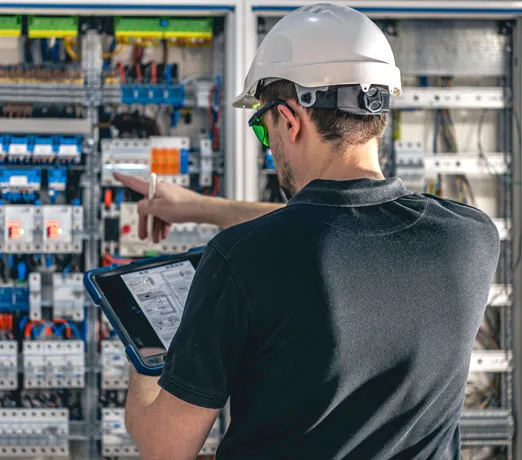
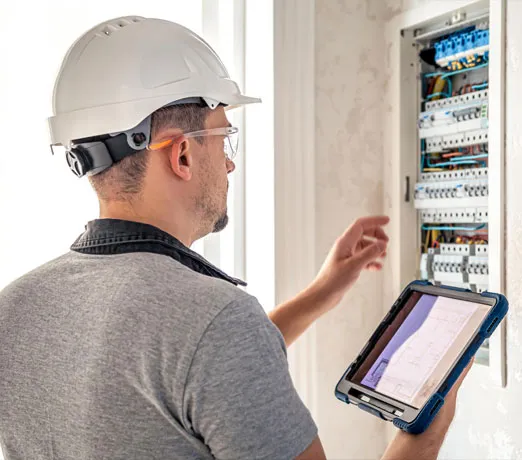
The curriculum is thoughtfully structured, beginning with core concepts such as circuit analysis, electromagnetics, and digital electronics, and advancing to specialized topics including power systems, control systems, microelectronics, electric vehicles, smart grids, and embedded systems. Emphasis is placed on hands-on learning through laboratory experiments, real-world projects, and industry internships, which foster critical problem-solving skills and technical competency.
Graduates of this program are well-prepared for diverse roles in the engineering sector, including positions such as power systems engineer, instrumentation and control engineer, electronics design engineer, and embedded systems developer. The program also builds a strong foundation for higher education and research, encouraging graduates to pursue M.Tech. or Ph.D. programs in specialized domains.
Course Curriculum
Programme Educational Objectives (PEOs)
The Program Educational objectives of the Electrical Engineering undergraduate program are to:
PEO-1
To provide students with the knowledge of Mathematics, Basic Engineering principles and Computing, Basic Sciences and Electrical and allied Engineering in particular so as to develop necessary skill to analyze and synthesize electrical circuits, algorithms and complex apparatus.
PEO-2
To prepare students as competent to analyze and provide economically feasible and socially acceptable solutions of real life technical problems in industry, research and academics related to energy, power, information, science, business and public policy.
PEO-3
To prepare students to be excellent professionals and adoptable at the global level having professional competence and administrative acumen ship so as to make him/her able to handle critical situations and deadlines ethically.
PEO-4
To indoctrinate an attitude to prepare and encourage students to undergo research work as well as to involve in scientific innovations for sustainable development in Electrical and allied Engineering.
PEO-5
To prepare graduates to communicate effectively, adopt lifelong learning, pursue higher education and act with Integrity and have interpersonal skills needed to engage in, lead and nurture diverse teams, with commitment to their ethical and social responsibilities.
Programme Outcomes (POs)
POs-1
Engineering knowledge:
Apply the knowledge of mathematics, science, engineering fundamentals, and an engineering specialisation for the solution of complex engineering problems.
POs-2
Problem Analysis:
Identify, formulate, research literature, and analyse complex engineering problems reaching substantiated conclusions using first principles of mathematics, natural sciences, and engineering sciences.
POs-3
Design / Development of Solutions:
Design solutions for complex engineering problems and design system components or processes that meet the specified needs with appropriate consideration for the public health and safety, and the cultural, societal, and environmental considerations.
POs-4
Conduct Investigations of Complex Problems:
Use research-based knowledge and research methods including design of experiments, analysis and interpretation of data, and synthesis of the information to provide valid conclusions.
POs-5
Modern Tool Usage:
Create, select, and apply appropriate techniques, resources, and modern engineering and IT tools including prediction and modelling to complex engineering activities with an understanding of the limitations.
POs-6
The Engineer and Society:
Apply reasoning informed by the contextual knowledge to assess societal, health, safety, legal and cultural issues and the consequent responsibilities relevant to the professional engineering practice.
POs-7
Environment and Sustainability:
Understand the impact of the professional engineering solutions in societal and environmental contexts, and demonstrate the knowledge of, and need for sustainable development.
POs-8
Ethics:
Apply ethical principles and commit to professional ethics and responsibilities and norms of the engineering practice.
POs-9
Individual and Team Work:
Function effectively as an individual, and as a member or leader in diverse teams, and in multidisciplinary settings.
POs-10
Communication:
Communicate effectively on complex engineering activities with the engineering community and with the society at large, such as being able to comprehend and write effective reports and design documentation, make effective presentations, and give and receive clear instructions
POs-11
Project Management and Finance:
Demonstrate knowledge and understanding of the engineering and management principles and apply these to one’s own work, as a member and leader in a team, to manage projects and in multidisciplinary Environments.
POs-12
Life-long Learning:
Recognise the need for, and have the preparation and ability to engage in independent and life-long learning in the broadest context of technological change.
Programme Specific Outcomes
The Program Specific Outcomes of the Electrical Engineering undergraduate program are:
PSO-1
Graduates will be able to apply the fundamental knowledge of mathematics, science and engineering to formulate, design and analyze and investigate complex power system problems in electrical and allied engineering horizons.
PSO-2
Graduates will be industry ready to design, develop and implement electrical and electronics and allied interdisciplinary projects to meet the contemporary demands of industry and provide solutions to the current real time problems related to power systems and electric drive systems.
PSO-3
Graduates will be aware of the impact of professional engineering solutions in societal, energy efficiency, environmental context, and professional ethics and able to demonstrate soft skill proficiency for sustainable global development.
PSO-4
Graduates will be able to apply the appropriate techniques and knowledge of modern engineering hardware and software tools in the electrical and allied engineering domain to engage in life-long learning and to successfully adapt in a multi-disciplinary environment.
Career Path
Alumni
Admissions
Faq's
Electrical Engineering is a branch of engineering that deals with the study, design, and application of systems and devices that use electricity, electronics, and electromagnetism. It encompasses a wide range of topics, including power generation, transmission, control systems, electronics, instrumentation, and modern computing technologies.
Graduates can work as Electrical Design Engineers, Power Systems Engineers, Automation Engineers, Embedded Systems Developers, and more. Opportunities also exist in government services, PSUs, and higher education or research. Electrical Engineering graduates have diverse career opportunities in sectors such as:
- Power generation and distribution
- Renewable energy (solar, wind)
- Electric vehicles and battery management
- Automation and control industries
- Consumer electronics and hardware design
- Industrial manufacturing
- Embedded systems and IoT
- Research and development
The program focuses on building hands-on skills through:
- Circuit design and simulation
- Power systems analysis and protection
- Microcontroller programming (e.g., Arduino, PIC, ARM)
- PLC, and industrial automation
- Embedded systems development
- Electrical machine control and instrumentation
- MATLAB, Simulink, and software tools
- Problem-solving through projects and labs
The curriculum is regularly updated to include technologies such as:
- Smart Grid and Microgrid Systems
- Renewable Energy Systems (Solar, Wind)
- Electric Vehicles (EV) and Battery Management Systems
- Internet of Things (IoT)
- Artificial Intelligence & Machine Learning in Electrical Systems
- Advanced Embedded Systems
- PLC and Automation
Yes, students participate in internships to gain hands-on experience in the electrical engineering industry.