MSc Agronomy Admission, Career Scope & Salary in India
A complete guide to M.Sc. in Agronomy (Agriculture) for B.Sc. Agriculture graduates-career paths, admission process, salary expectations, and why this specialization matters.
Introduction
You've finished your B.Sc. Agriculture, and now you're standing at a crossroads. The job market is calling-there are agricultural officer positions, seed company roles, and government opportunities within reach. But there's another voice whispering: What if I went deeper?
That's where MSc Agronomy enters the picture - the M.sc. in Agriculture program with a specialization in Agronomy.
Higher education in agriculture isn't just about getting a better paycheck (though that matters). It's about specialization in a field that's fundamentally changing. Traditional farming is giving way to precision agriculture, climate-smart practices, and data-driven crop management. These aren't buzzwords-they're the future of how the world feeds itself. An MSc Agronomy degree positions you at the center of that shift.
Many B.Sc. Agriculture graduates choose MSc Agronomy because they've glimpsed the limitations of general agricultural knowledge. A broad B.Sc. gives you fundamentals, but it leaves you asking questions: Why does this crop fail in drought? How can we optimize soil nutrients across 100 hectares? What's the real science behind crop rotation? Those questions aren't answered at the undergraduate level. The Master’s in Agriculture Field with a focus on Agronomy provides those answers and so much more.
Agronomy, at its core, is the science and practice of field-crop production and soil management. It sounds technical, but it's essentially applied ecology-understanding how plants, soil, water, and climate interact, and using that knowledge to grow food more efficiently, sustainably, and resiliently. Agronomy, at its core, is the science and practice of field-crop production and soil management. It sounds technical, but it's essentially applied ecology-understanding how plants, soil, water, and climate interact, and using that knowledge to grow food more efficiently, sustainably, and resiliently.
What is MSc Agronomy? Mastering Modern Farming & Sustainable Agriculture
Let's get specific: Msc Agronomy - formally called the master degree in Agriculture with a specialization in Agronomy - is the field science of optimizing crop production. It answers questions like: Which crop variety thrives in saline soil? How do you manage weeds without excessive herbicide use? What irrigation schedule maximizes yield per water unit? If you're pursuing an MSc Agronomy degree, you're investing in mastery over these practical, high-impact problems.
The scope of agronomy in modern agriculture is enormous. Here's why it matters:
Food security - With the global population heading toward 10 billion by 2050, we need to produce more food on less arable land. Agronomists make that possible through higher yields and sustainable practices.
Climate resilience - Irregular rainfall, heat waves, and shifting growing seasons demand crops and practices adapted to new realities. Agronomy is the discipline making agriculture climate-ready.
Sustainability - Chemical-intensive farming is exhausting soils and polluting water. Agronomists develop systems that maintain productivity while regenerating natural resources.
Precision agriculture - Soil sensors, drones, and satellite imagery are flooding agriculture with data. Agronomists interpret that data and translate it into actionable farm decisions.
The role of an agronomist in this landscape? You become a bridge-between scientific innovation and practical farming. You run field trials, publish research, advise farmers, and develop technologies that actually work in the real world. It's research and applied problem-solving combined.
Why choose MSc Agronomy (Master of Science in Agriculture) after B.Sc. Agriculture?
The honest answer: because your B.Sc. taught you agriculture, but your MSc Agronomy teaches you to think like an agronomist.
Specialization and depth - Your B.Sc. covered soil science, plant science, entomology, plant pathology-a broad toolkit. The Master of Science in Agriculture program with Agronomy specialization narrows your focus to how crops grow in specific environments. You study dryland farming, irrigation management, soil fertility, cropping systems in exacting detail. An MSc Agronomy degree makes you genuinely expert-level on topics that matter.
Academic growth - You'll design your own research project and execute it over a full season. That's not group assignments; that's your own hypotheses, your data, your conclusions. You'll publish papers, present at conferences, and build a portfolio that matters.
Better career prospects - A B.Sc. gets you agricultural officer or junior scientist roles. An MSc Agronomy degree opens senior scientist positions, consultant roles, leadership in agritech, and research fellowships. The Master of Science in Agronomy qualification significantly boosts your earning potential-₹2 – 4 LPA higher at entry, and that gap widens with experience.
Research and innovation opportunities - If you want to solve problems-developing drought-resistant crop varieties, designing regenerative farming systems, optimizing fertilizer use-the MSc Agronomy program gives you the foundation. Doors open to ICAR research institutes, international agricultural organizations, and startup innovation in agritech.
Contribution to food security and sustainability - This isn't sentimental. Agriculture feeds 1.4 billion Indians directly and billions more worldwide. Your work as an agronomist has direct impact on whether families eat well, whether soil stays fertile for your children's generation, whether farming remains viable as climate shifts. Few fields offer that tangible purpose.
Eligibility criteria
Before you apply, check if you meet the basics:
Educational qualifications. You need a B.Sc. in Agriculture (or allied disciplines: agricultural engineering, horticulture, forestry, veterinary science). Some universities accept B.Tech. in relevant fields; check individual requirements.
Minimum percentage. Most state agricultural universities (SAUs) require 50–55% in your B.Sc. ICAR-affiliated institutions and top-tier universities (IARI, PAU, TNAU) are stricter-they typically want 60%+ or top rank. A few elite programs want 65%+. If your B.Sc. marks are on the lower end, don't panic: entrance exam scores often carry more weight, especially for ICAR programs.
Entrance examination requirements. This is where things get important. ICAR-affiliated institutions mandate the All India Entrance Examination for Admission (AIEEA) PG. State agricultural universities run their own entrance exams with different syllabi and formats. Some universities offer merit-based direct admission without an entrance exam, based purely on your B.Sc. marks. Research your target university's specific requirement-don't assume all M.Sc. Agronomy programs follow the same path.
Admission process
Understanding the timeline and mechanics helps you plan:
ICAR PG Entrance Examination (AIEEA PG). This is the gateway to most central ICAR institutions (IARI, TNAU, GBPUAT, etc.). Registration typically opens in January–February, exams happen in April–May. The exam tests general agriculture, basics of agronomic sciences, and analytical thinking. It's competitive-thousands appear, but only top-ranked candidates secure seats at premier institutions. AIEEA is conducted by the National Test Agency (NTA).
State Agricultural University entrance exams. SAUs in Punjab, Haryana, Uttar Pradesh, Maharashtra, and other states conduct their own exams (often in May–June). These are usually less competitive than ICAR but vary by university. Some SAUs accept ICAR scores; others don't.
University-specific admission procedures. After the entrance exam, universities release merit lists. Admission is based on your exam rank, sometimes combined with your B.Sc. marks. You get a certain window to accept your offer-usually 2–4 weeks. Some universities have reserved seats for specific categories (SC/ST/OBC), and some have faculty scholarships for meritorious students.
Private universities – You can also opt for a private university, which can be an excellent choice for pursuing an M.Sc. in Agronomy. Many private institutions offer modern infrastructure, industry-oriented curricula, experienced faculty, research opportunities, and strong academic support. Admissions are generally based on university-specific entrance tests, merit in the qualifying examination, or a combination of both. Private universities often have a simpler admission process and may provide scholarships to deserving students based on academic performance or entrance test scores.
Important preparation tips for aspirants:
Start studying 4–5 months before the entrance exam.
Focus on applied agronomy rather than rote memorization-AIEEA questions test understanding and application.
Study previous years' question papers; they reveal patterns and difficulty levels.
Take mock exams under timed conditions; managing time is half the battle.
Join study groups or coaching institutes if self-study isn't working for you-don't wait until it's too late.
Course duration and structure
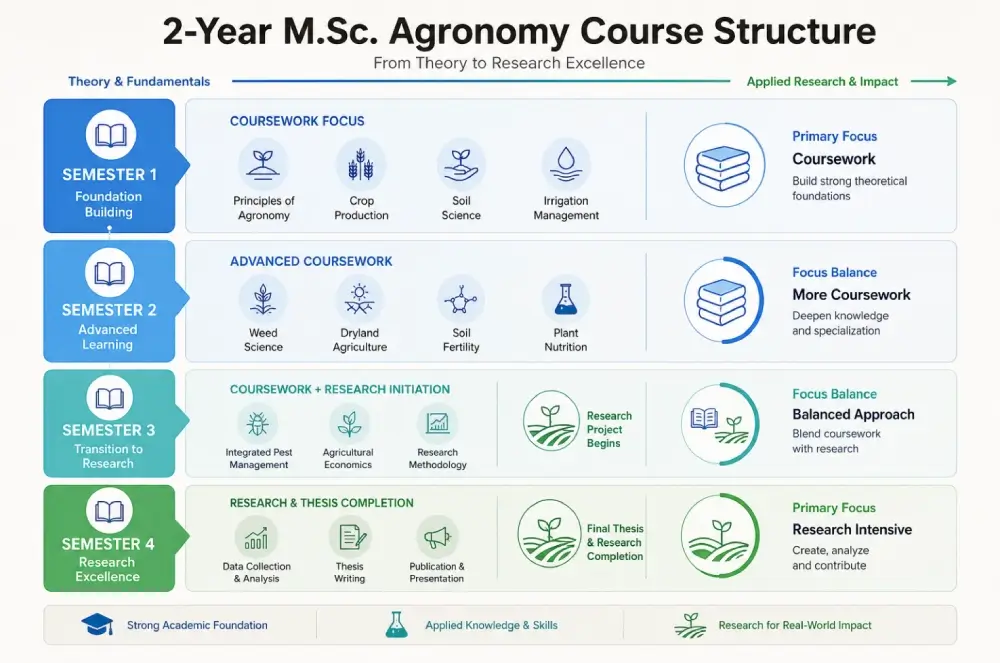
The MSc Agronomy degree, formally known as the Master of Science in Agriculture with Agronomy specialization, is a 2-year full-time program in most universities, divided into four semesters. Here's how the MSc Agronomy program typically breaks down:
Semester-wise pattern- Semesters 1 and 2 (first year) are course-heavy: you take 6–8 subjects per semester, with lectures, practical sessions, and exams. Subjects include Principles of Agronomy, Crop Production, Soil Fertility, Irrigation, Weed Science, and maybe one elective. Semesters 3 and 4 (second year) reduce coursework and front-load research: you take 2–3 subjects, but you're deeply involved in your research project (field trials, data collection, analysis, writing).
Coursework and research components - Your M.Sc. isn't just a classroom degree. By the end of first year, you've identified your research question (often in collaboration with your advisor). In the second year, you execute field trials, collect and analyze data, and write a detailed thesis. This research is the crown jewel of your M.Sc.-it's what gets published, what conferences invite you to present, and what impresses employers.
Thesis/dissertation requirements - Most universities require a formal thesis (usually 40–60 pages) documenting your research. You defend it before an internal examiner and an external examiner. It's rigorous, and that rigor is exactly why employers value an M.Sc. graduate-you've proven you can conduct independent research.
Major subjects covered in M.Sc. Agronomy
The curriculum dives deep into crop sciences and soil management:
Principles of Agronomy gives you the theoretical foundation-crop ecology, plant-environment interactions, agro-meteorology. Crop Production and Management is about specific crops: rice, wheat, maize, cotton, pulses-how to grow them, optimize yield, manage diseases and pests. Weed Science is more specialized than it sounds-it covers weed identification, biology, management strategies (chemical, mechanical, biological), and herbicide-resistant weed management. Dryland Agriculture teaches you to farm in semi-arid regions where water is scarce-soil water conservation, crop selection, and cropping patterns that work in low-rainfall zones.
Irrigation and Water Management covers irrigation scheduling, methods (drip, sprinkler, flood), and water-use efficiency. As water scarcity increases, this skill becomes increasingly valuable. Soil Fertility Management digs into nutrient cycles, soil testing, fertilizer recommendations, and organic matter management. Cropping Systems explores how to combine crops strategically-intercropping, sequential cropping, and rotations that maintain soil health and optimize land use.
Emerging subjects that reflect modern agriculture: Climate-Smart Agriculture addresses farming in the face of climate change-crop varieties and practices resilient to new weather patterns. Precision Agriculture uses sensor data, GIS, and automation to optimize inputs and maximize efficiency. Sustainable Agriculture Practices covers regenerative farming, conservation agriculture, and agroforestry-approaches that prioritize long-term sustainability over short-term yield maximization.
Skills developed during M.Sc. Agronomy
An M.Sc. teaches you more than facts; it develops professional capabilities:
Research and analytical skills. You learn to design field trials, control variables, collect rigorous data, and draw valid conclusions. These skills transfer to any problem-solving role.
Experimental design and data analysis. You become fluent in statistical analysis (ANOVA, regression, hypothesis testing). You use software like R or SPSS. Employers value this highly.
Problem-solving abilities. You're presented with a field problem-say, declining yields in a specific crop-soil combination-and you have to solve it. That's the daily reality of agronomy research.
Scientific writing and communication. You write research proposals, thesis chapters, and eventually papers. You learn to communicate complex ideas clearly. That's invaluable everywhere.
Leadership and project management. As your research project grows, you coordinate field assistants, manage budgets, and meet deadlines. You're running a mini-project for two years-that's leadership training.
Career opportunities after MSc Agronomy (Master of Science in Agriculture)
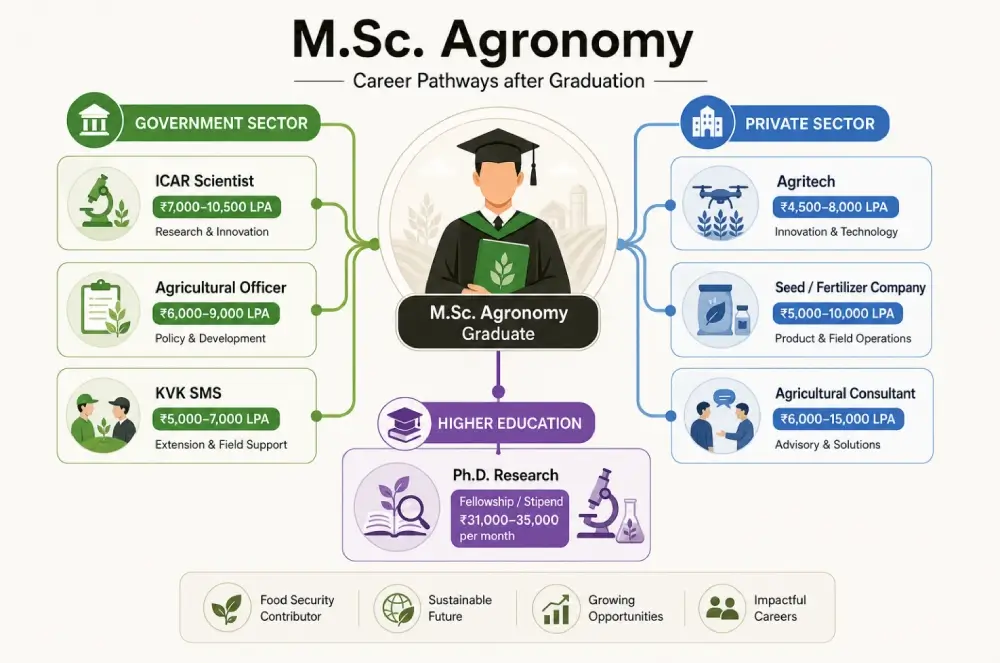
This is where it gets tangible. Here's what you can actually do with an MSc Agronomy degree or Master of Science in Agriculture qualification:
This is where it gets tangible. Here's what you can actually do with an M.Sc. Agronomy:
Agricultural Officer - government role managing agricultural extension, crop advisory, and scheme implementation. Stable job, decent salary, pension.
Agronomist - independent consultant advising farmers on crop choices, soil management, and modern practices. Can be self-employed or company-based.
Research Associate - work at ICAR institutes, universities, or private research organizations on applied or fundamental research.
Scientist - ICAR scientist positions at ranks Junior Scientist, Senior Scientist, Principal Scientist. Conduct research, mentor students, influence agricultural policy.
Subject Matter Specialist (SMS) - Krishi Vigyan Kendras and state agriculture departments employ SMS to provide localized agricultural advice. Direct farmer interaction, meaningful work.
Assistant Professor/Lecturer - teach at agricultural colleges or universities. Combine teaching and research.
Agricultural Consultant - advise large-scale farming operations on crop strategy, soil management, and modern farming technologies.
Project Coordinator - lead agricultural development projects for NGOs, government agencies, or international organizations.
Seed Industry Professional - work for seed companies in research, product development, or field management.
Fertilizer and Agrochemical Industry Roles - product development, agronomic support, field trials.
Government job opportunities
Government jobs in agriculture are stable, come with pensions, and offer respect. Here are the main pathways:
ICAR institutions - IARI (Indian Agricultural Research Institute), TNAU (Tamil Nadu Agricultural University), PAU (Punjab Agricultural University). ICAR scientist positions are highly competitive but well-paid (₹7–10 LPA entry). You need to clear the ICAR recruitment exams.
State Agriculture Departments - every state has one. Roles range from agricultural officer to senior scientist. Competitive exams, permanent positions.
Agricultural Development Officer positions - coordinate agricultural development at block or district level.
NABARD - National Bank for Agriculture and Rural Development offers roles in agricultural project management and research.
Agricultural Universities - lecturer or assistant professor positions. Competitive, based on merit and exams.
Krishi Vigyan Kendras (KVKs) - science extension centers run by ICAR. Subject Matter Specialist positions are sought-after.
Private sector opportunities
Private sector offers faster growth and often higher salaries, but less job security than government:
Seed companies - Syngenta, Mahyco, Bayer, Corteva. Roles in crop breeding, field trials, agronomy, product management. Entry salary ₹4–7 LPA, growth to ₹12 – 20+ LPA in senior roles.
Fertilizer companies - Deepak Fertilizers, UPL, FACT. Agronomic support roles, field trials, farmer advisory.
Agrochemical companies - pest and disease management products. Roles in product development, registration, field extension.
Agritech startups - the fastest-growing segment. Companies like AgroWin, ICrops, Waycool, Ninjacart. Roles in soil analytics, crop monitoring, advisory tech. Salary competitive, equity potential, fast growth.
Agricultural consulting firms - advisory companies serving large farming operations or agricultural companies.
Contract farming organizations - manage large-scale contract farming arrangements between corporates and farmers.
Research and higher education opportunities
If your passion is research, the path is clear:
Ph.D. in Agronomy - pursue directly after M.Sc. ICAR Junior Research Fellow (JRF) and Senior Research Fellow (SRF) programs offer stipends (₹31,000–35,000/month JRF, higher for SRF) while you do your Ph.D. at an ICAR institute or university. The 3–5 year journey is challenging but rewarding.
Research fellowships - international programs. TWAS fellowships, DAAD scholarships, and bilateral programs between India and countries like USA, Germany, Australia offer funded Ph.D. positions.
International higher education opportunities - universities worldwide value Indian M.Sc. Agriculture graduates. You can pursue M.S./Ph.D. in crop science, plant genetics, or sustainable agriculture at institutions in USA, Europe, or Australia.
Research careers in national and international organizations - CGIAR centers (CIMMYT, ICRISAT, IRRI), FAO, World Bank, and UN agencies employ agricultural research scientists. These roles combine research with global impact.
Expected salary after M.Sc. Agronomy
Let's talk about money. Salary is a factor-be honest about it:
Fresh graduate salary range - ₹4 – 7 LPA in private sector (agritech startups, seed companies), and MNCs may offer ₹6–10 LPA to exceptional candidates.
Government sector salary expectations - Entry-level ICAR Scientist joins at Pay Level 10 with Basic Pay ₹56,100/month (₹6.73 lakh basic annually). After DA, HRA and other allowances, the gross annual package is approximately ₹9–11 lakh, and in-hand is generally ₹75,000–90,000/month, depending on the city.
Private sector salary expectations - Entry-level salaries generally range from ₹4.5–7 LPA, although top agribusiness firms and multinational companies may offer higher packages. Career growth in the private sector is typically faster than in government jobs. After 5–7 years of experience, professionals commonly earn ₹8–15 LPA, while high performers in reputed organizations may reach ₹15–20 LPA. Senior managerial and technical leadership roles can exceed ₹25–30 LPA. Agritech startups may also offer stock options or equity, which can significantly increase long-term earnings if the company performs well.
Is M.Sc. Agronomy is the right choice for you?
Before you commit, ask yourself these questions:
Self-assessment questions: Do you genuinely enjoy fieldwork, or do you prefer lab/office settings? Are you interested in research, or do you prefer applied advisory roles? Can you handle uncertainty-field trials that fail, weather that disrupts plans? Are you motivated by solving real farming problems, or are you pursuing the degree for salary alone?
Suitable personality traits. Successful agronomists are observant (noticing subtle plant symptoms), patient (research takes time), systematic (good documentation and analysis), and collaborative (you work with farmers, researchers, and company teams). If you're detail-oriented and care about practical outcomes, you'll thrive. If you prefer theoretical work or highly controlled environments, reconsider.
Career goals alignment. Do your goals align with agronomic careers? If you want to run a consulting firm, teach, conduct research, or work in agritech, then yes. If your dream is finance, law, or tech entrepreneurship (unrelated to agriculture), an M.Sc. in Agronomy is a detour.
Conclusion
M.Sc. Agronomy after your B.Sc. Agriculture isn't just a degree upgrade. It's a specialization that positions you at the center of how food gets grown in a changing world. You'll master crop science, research methods, and modern farming practices. You'll open doors to government scientist roles, agritech companies, consulting, or academia. You'll have the skills to solve real problems-how to grow more food with less water, how to keep soil fertile for generations, how to help farming adapt to a changing climate.
Is it easy? No. The entrance exam is competitive, fieldwork is demanding, and the research timeline is unforgiving. Is it worth it? For most graduates who take this path, absolutely. The salary is solid, the career satisfaction is high, and the impact is tangible-you're feeding a country of 1.4 billion people.
If you love farming, problem-solving, and the idea of innovation at the intersection of science and real-world agriculture, take the plunge. Your B.Sc. has prepared you. Now go specialize, conduct research, and become the agronomist modern agriculture desperately needs.
Frequently Asked Questions (FAQs)
Q1. What is the minimum percentage required for M.Sc. Agronomy admission?
Answer: Most agricultural universities require a minimum of 50–60% in B.Sc. Agriculture. Top-tier ICAR institutions like IARI and PAU may have higher cut-offs (65%+). Check individual university requirements, as they vary. Your entrance exam score often matters more than your undergraduate percentage.
Q2. Is ICAR entrance exam mandatory for all M.Sc. Agronomy programs?
Answer: ICAR-affiliated institutions require the AIEEA PG exam. However, many state agricultural universities (SAUs) conduct their own entrance exams with different formats and cut-offs. Some universities also offer merit-based direct admission based on your B.Sc. marks. Check your target university's admission criteria early otherwise you can opt for private universities.
Q3. What's the starting salary after M.Sc. Agronomy?
Answer: Government ICAR scientist positions start at ₹7–10 LPA depending on the level (Junior Scientist or higher). Private sector roles in agritech, seed, and fertilizer companies range from ₹4 – 7 LPA. Salaries grow significantly with experience, reaching ₹15 –25 LPA in 5–10 years according to your performance.
Q4. Can I pursue a Ph.D. after M.Sc. Agronomy?
Answer: Absolutely. Many M.Sc. graduates pursue Ph.D. through ICAR Junior Research Fellow (JRF) or Senior Research Fellow (SRF) programs, offering monthly stipends of ₹31,000–35,000. International Ph.D. opportunities are also available through scholarships and collaborative programs.
Q5. Is there job security in agronomy after higher education?
Answer: Yes. Government institutions (ICAR, KVK, state agriculture departments) offer permanent positions. Private sectors (agritech, seed/fertilizer companies) are growing rapidly. Agriculture is fundamental to food security, so demand remains stable. However, competitive exams for government roles are selective.
 Back
Back


 About
About