A patient walks into the emergency room with chest pain. Within minutes, an ECG is running, a blood sample is on its way to the lab, and an X-ray is being prepared.
A patient walks into the emergency room with chest pain. Within minutes, an ECG is running, a blood sample is on its way to the lab, and an X-ray is being prepared. By the time the doctor sits down to decide on treatment, much of the information needed for that decision has already been collected.
None of that happens by chance. It happens because of a large group of trained professionals who rarely get the spotlight: the technologists, therapists and technicians who run the tests, operate the machines and support every stage of patient care.
That group is the world of allied health science. In this guide, we will explain what allied health science is, how it differs from medicine and nursing, the main branches within it, the skills it demands, and how you can build a career in it.
What Is Allied Health Science?
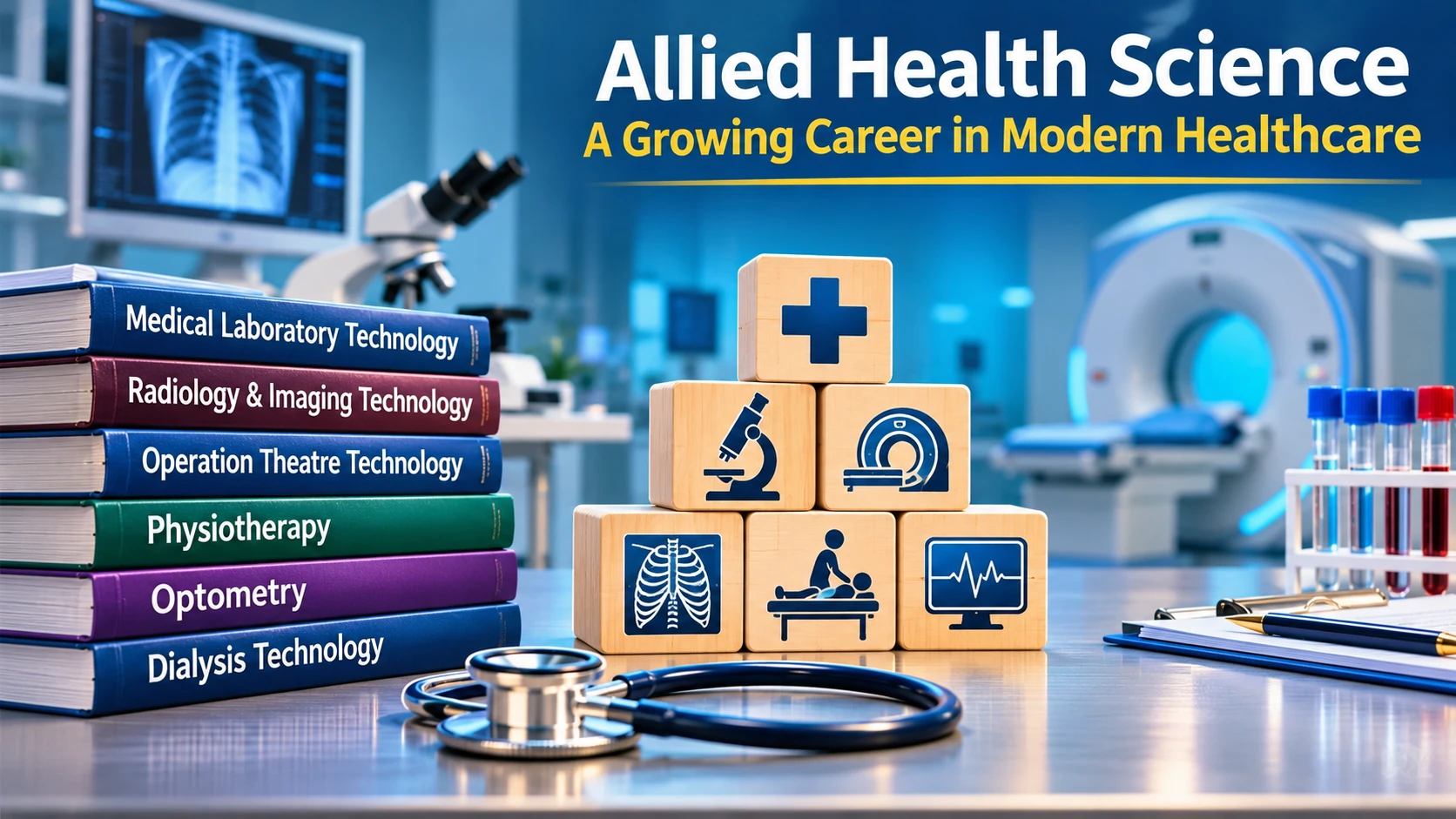
Allied health science is the field of study and practice that trains healthcare professionals who support the diagnosis, treatment, rehabilitation and prevention of illness, outside the traditional roles of doctors and nurses.
The word allied simply means working alongside. These professionals work in partnership with doctors, surgeons and nurses, and they bring specialised technical skills that modern healthcare depends on.
In India, allied health education and practice are now regulated under the National Commission for Allied and Healthcare Professions (NCAHP) Act, 2021. The framework recognises ten categories of professionals and more than 50 allied and healthcare professions.
In short, allied health science covers the clinical, diagnostic and therapeutic skills that keep a hospital running every hour of the day.
Why Allied Health Science Matters
Before a doctor can treat a condition, it has to be identified, measured and monitored. After treatment, the patient often needs rehabilitation and follow-up. Allied health professionals are involved at each of these stages.
Their work matters because:
Diagnosis depends on accurate testing: Imaging, laboratory and cardiac tests produce the evidence that guides treatment decisions.
Procedures need skilled support: Surgeries and critical-care treatments rely on trained technologists managing equipment and patient safety.
Recovery is a process: Rehabilitation and therapy help patients return to normal life after illness or injury.
Healthcare is growing: As hospitals, diagnostic chains and specialty centres expand, so does the need for trained technical staff.
Allied Health Professionals vs Doctors vs Nurses
Allied health roles are often confused with other healthcare roles. The comparison below shows how they differ.
Aspect
Doctors
Nurses
Allied Health Professionals
Core role
Diagnose and prescribe treatment
Deliver ongoing patient care and administer treatment
Perform specialised tests, procedures and therapies
Focus
Medical decision-making
Patient care and monitoring
Technical, diagnostic and rehabilitative support
Typical work
Consultations, surgery, treatment plans
Ward care, medication, patient education
Scans, lab tests, cardiac tests, OT support, therapy
No role is more important than the others. Good patient care happens when all three work together.
9 Common Branches of Allied Health Science
Allied health is not a single discipline. It is a family of specialisations, each with its own tools, skills and career path. Here are nine of the most common branches.
Medical Laboratory Technology
Laboratory technologists test blood, urine, tissue and other samples to detect disease. Their work in pathology, microbiology and biochemistry supports a large share of clinical decisions.
Medical Radiology and Imaging Technology
Imaging technologists operate X-ray, CT, MRI and ultrasound equipment to produce images of the inside of the body, while following strict radiation safety practices.
Operation Theatre and Anaesthesia Technology
These professionals prepare operation theatres, manage surgical equipment and assist anaesthesia teams in monitoring patients before, during and after procedures.
Cardiovascular Technology
Cardiac technologists conduct and support tests such as ECG, echocardiography and stress testing, and assist in cardiac catheterisation procedures.
Physiotherapy
Physiotherapists help patients regain movement and function after injury, surgery or illness through exercise, manual therapy and rehabilitation planning.
Respiratory Care Technology
Respiratory technologists support patients with breathing difficulties, managing ventilators, oxygen therapy and lung function testing.
Dialysis technologists operate dialysis machines and monitor patients with kidney failure during treatment.
Emergency and Trauma Care Technology
Emergency care professionals provide rapid response and life support in accident, trauma and critical-care situations.
The list does not end here. Occupational therapy, speech and hearing sciences, nutrition and dietetics, and medical records and health information management are also part of the wider allied health landscape.
Allied Health Science in Action: Real-World Examples
The easiest way to understand allied health science is to follow a patient through a hospital.
A Suspected Heart Condition
A cardiac technologist records an ECG and performs an echocardiogram. The results help the cardiologist decide whether the patient needs medication, further tests or a procedure.
An Accident Victim
An imaging technologist positions the patient for an X-ray or CT scan, while a laboratory technologist processes blood tests and cross-matching in the background.
A Planned Surgery
The operation theatre technologist prepares the theatre and instruments, and the anaesthesia technologist supports monitoring while the surgical team operates.
A Long Recovery
After surgery or injury, the patient works with a physiotherapist who designs a step-by-step rehabilitation plan.
In every one of these stories, the doctor leads, but the outcome depends on a team of allied health professionals working in sync.
Technologies Used in Allied Health Science
Allied health work is closely linked with technology. Depending on the specialisation, professionals work with:
Digital X-ray, CT and MRI systems for imaging
Ultrasound and echocardiography machines for real-time views of organs
ECG and cardiac monitoring equipment for heart assessment
Automated laboratory analysers for fast, accurate testing
Anaesthesia workstations and patient monitors in operation theatres
Ventilators and respiratory support devices for critical care
AI-assisted diagnostic software, which is increasingly used to support image and data analysis
Learning to operate, maintain and troubleshoot these systems safely is a core part of allied health training.
Skills Needed to Build a Career in Allied Health Science
Allied health professionals sit at the intersection of science, technology and patient care, so the skill set is broader than many students expect.
Scientific Knowledge
Human anatomy and physiology
Basics of pathology, microbiology and biochemistry
Understanding of diseases and how they are diagnosed
Technical Skills
Operating and maintaining clinical and diagnostic equipment
Following infection control and safety protocols
Accurate recording and handling of patient data
Professional Skills
Clear communication with patients, families and clinical teams
Empathy and patience in stressful situations
Attention to detail, since errors in this field can affect patient safety
Ethical conduct and respect for patient privacy
How to Study Allied Health Science in India
Most students enter this field after Class 12 with Physics, Chemistry and Biology (PCB), through a B.Sc (Hons) programme in a specific discipline. These programmes generally combine classroom study, laboratory training and a clinical internship.
What Is Changing in 2026–27
Allied health education is becoming more standardised. NCAHP has released curricula for 17 allied health courses to be implemented from the 2026–27 academic year, and has stated that NEET UG is a basic eligibility criterion for notified allied and healthcare undergraduate courses from the same session. Since notifications can change, students should check the latest NCAHP updates and the university's admission page before applying.
After a bachelor's degree, graduates can also pursue postgraduate study, specialised certifications or research in their field.
Studying Allied Health Science at Medicaps University
For students who want to turn this interest into a career, the Department of Allied Health Sciences at Medicaps University, Indore, offers B.Sc (Hons) programmes under the Faculty of Science. The department focuses on practical training, clinical exposure and industry-aligned education, with hospital internships, laboratory work and real-world case studies.
Core medical sciences such as anatomy, physiology and pathology
Specialisation subjects specific to the chosen programme
Laboratory sessions for hands-on practice
Clinical postings and internship under supervision
Admission at Medicaps
Applicants can apply through the Medicaps admissions portal. Eligibility, entrance requirements and fees can vary by programme and session, so confirm the latest details with the admissions office. Information on financial support is available on the scholarship page.
Career Pathways After the Programme
Graduates are prepared for roles such as:
Operation theatre technologist or anaesthesia technician
Cardiac technologist in cath labs and cardiac care units
Radiographer, CT technologist or MRI technologist
Medical laboratory technologist in hospitals and diagnostic labs
Technical roles with healthcare service providers and medical equipment companies
Postgraduate student or researcher in allied health disciplines
Conclusion
So, what is allied health science in the end? It is the part of healthcare that turns medical decisions into action: the tests that reveal the problem, the procedures that treat it and the therapy that helps patients recover.
As healthcare in India expands and standards become more uniform under NCAHP, the need for trained allied health professionals will keep growing. For students with a PCB background who want a practical, skill-based healthcare career, this field offers a clear and rewarding path.
What does allied health science mean in simple words?
Allied health science is the study of healthcare professions that support doctors and nurses, such as laboratory technology, imaging, cardiac care, operation theatre support and rehabilitation.
Is allied health science the same as paramedical science?
The two terms are often used interchangeably in everyday conversation. Allied health is the more current and formal term, and it is the one used in the NCAHP framework.
Is allied health science a good career in India?
It can be, particularly for students who want a technical, hospital-based career. Demand is linked to the growth of hospitals, diagnostic centres and specialty healthcare services.
Which subjects are required to study allied health science after 12th?
Most B.Sc allied health programmes require Physics, Chemistry and Biology in Class 12. Always check the eligibility for your chosen programme.
Is NEET required for allied health courses?
NCAHP has said NEET UG is a basic eligibility criterion for notified allied and healthcare undergraduate courses from 2026–27. Check the latest NCAHP notices and the university's admission page for the criteria that apply to your programme.
How long does a B.Sc allied health course take?
These programmes are generally structured over four years, including a clinical internship. Confirm the exact duration with the university.
What is the difference between allied health and nursing?
Nursing focuses on continuous patient care, medication and ward management. Allied health professionals specialise in diagnostic, technical and therapeutic roles such as imaging, laboratory testing, cardiac testing and rehabilitation.
Can I pursue higher studies after an allied health degree?
Yes. Graduates can pursue postgraduate programmes, specialised certifications or research in their field, depending on the discipline.
 Back


 About