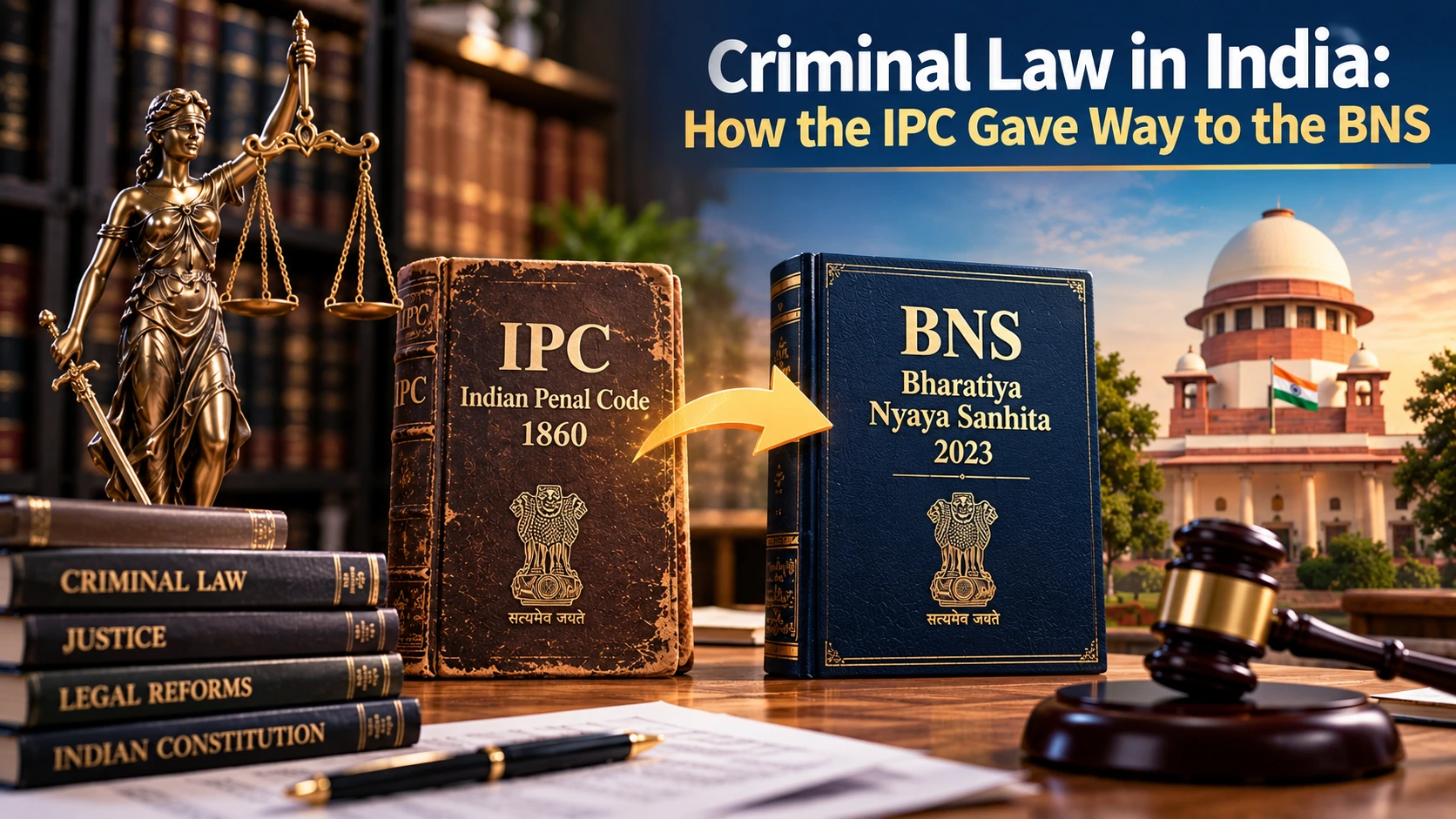
Criminal Law in India: How the IPC Gave Way to the BNS
Criminal law touches every citizen in the country. A stolen phone or a road accident or a long wait for a court verdict all fall under it.
Criminal law touches every citizen in the country. A stolen phone or a road accident or a long wait for a court verdict all fall under it. Since 1 July 2024 the whole system has been rewritten. The Indian Penal Code of 1860 has been replaced by the Bharatiya Nyaya Sanhita, 2023.
This guide explains the meaning of criminal law and its history. The shift from IPC to BNS is covered along with the new laws of procedure and evidence. The stages of a case and the career paths after law school are also described. Details of the Faculty of Law at Medicaps University are shared too. Simple language has been used on purpose because the law should be understood by the people it governs.
The Meaning of Criminal Law in India
Criminal law is the body of rules that decides which acts are offences. How those offences are investigated and tried is also laid down by it. Punishment for the guilty is prescribed by it as well. A crime is seen as a wrong against society as a whole. That is why a criminal case is titled State versus the accused even when only one person was harmed.
Three pillars are formed by the system. They are easy to remember as what and how and proof.
Offences and punishments are defined by the Bharatiya Nyaya Sanhita, 2023 (BNS).
FIRs and arrests and bail and trials are governed by the Bharatiya Nagarik Suraksha Sanhita, 2023 (BNSS).
The rules of evidence are laid down by the Bharatiya Sakshya Adhiniyam, 2023 (BSA).
Five purposes are served by criminal law. People and property are protected. Wrongdoing is discouraged. Offenders are punished. Reform is attempted wherever it is possible. Public order is maintained. One of these aims is at work whenever an arrest or a bail order or a conviction is reported. How free and how safe a person is depends on this law. How fairly the state treats that person depends on it too.
A. Short History from Macaulay to Modern Times
The history of this subject is a favourite of mine. It shows how long a single idea can survive. Local customs and religious codes and royal orders were followed before the British arrived. The same act could be punished differently in different regions. A uniform code was wanted by the colonial rulers, and the story began there.
In 1834 the first Law Commission started work under the Charter Act of 1833. It was headed by Thomas Babington Macaulay.
In 1860 the Indian Penal Code was enacted. It came into force on 1 January 1862.
In 1872 the Indian Evidence Act was passed. It was largely drafted by James Fitzjames Stephen.
In 1973 a new Code of Criminal Procedure was passed to replace the older one of 1898. It was brought into force in 1974.
In 2013 sexual offences were given a wider definition and harsher punishments after the Delhi gang rape of December 2012.
In December 2023 the BNS and BNSS and BSA were assented to by the President after being passed by Parliament.
On 1 July 2024 all three laws were brought into force.
The IPC was used for over 160 years. Versions of it are still followed in several former British colonies. Society and technology and constitutional values changed so much over time that a fresh start was thought necessary by lawmakers.
Criminal Law and Civil Law Compared
Students often ask how the two differ. The answer is that they sometimes overlap.
Disputes between private parties are settled by civil law. A broken contract or a property claim or a divorce is a typical example. Compensation or an order to act is usually what is sought. Acts treated as offences by the state are handled by criminal law. Punishment and deterrence and public protection are the goals there.
Evidence is also treated differently. A civil case is decided on a balance of probabilities. Guilt must be proved beyond reasonable doubt by the prosecution in a criminal case. That bar is far higher. A civil loss usually means money has to be paid. A criminal conviction can mean a prison term and a lasting record.
Both kinds of case can arise from a single event. A rash driver may be prosecuted by the state. Compensation may be claimed by the victim in a separate civil forum. A good lawyer needs to understand both sides for this reason.
What Makes an Act a Crime
Two ingredients are needed for most crimes and they are taught first to every student. The guilty act is called actus reus. The guilty mind is called mens rea. A bad thought alone is not punished. An act done without intention or knowledge or negligence is generally not punished either. Strict liability offences are created by some special laws and intention is not required for them.
A crime is also seen to pass through stages. Intention comes first and then preparation and then attempt and finally commission. Bare intention and preparation are usually not punishable. An attempt often is. The harm must also be caused by the act itself.
Important safeguards are given to every accused person by the Constitution.
A person is presumed innocent until a court decides otherwise. The burden of proof is placed on the prosecution.
Under Article 20 nobody can be punished under a law that did not exist at the time of the act. Nobody can be tried twice for the same offence. Nobody can be forced to give evidence against themselves.
Under Article 21 life and liberty can be taken away only by a fair and reasonable procedure.
Under Article 22 the grounds of arrest must be told to the arrested person. A lawyer can be consulted. A magistrate must be reached within 24 hours.
Where Criminal Law Comes From
Four sources can be listed. The first is the Constitution. The limits within which every criminal law must work are set by it. The second is statute law. The main codes are the BNS and BNSS and BSA. Special laws are added to these. The POCSO Act and the NDPS Act and the UAPA and the Information Technology Act are examples.
The third source is judicial precedent. All courts in India are bound by Supreme Court decisions. Gaps left by statutes are often filled by them. The fourth source is international human rights conventions. These are sometimes used by courts to interpret domestic law.
Why the IPC Was Replaced
Colonial language and priorities were to be removed according to the government. Modern crimes were to be addressed and justice was to be made faster. A different point has been raised by critics. A large part of the BNS is said to be the old IPC rearranged and renumbered. Thousands of section numbers had to be relearned by lawyers and police and judges. Some truth can be found in both views. The text of the law should be read by you instead of relying on headlines.
The three new laws can be compared with the old ones.
The IPC is replaced by the BNS. It has 358 sections against 511 in the old code.
The CrPC is replaced by the BNSS. It has 531 sections against 484 in the old code.
The Evidence Act is replaced by the BSA. It has 170 provisions against 167 in the old Act.
One practical point matters a great deal. Offences committed before 1 July 2024 are still dealt with under the old laws. The IPC will therefore be seen in courtrooms for many more years.
Major Changes Brought by the BNS
Offences against women and children are placed before murder. A change of priorities is signalled by this order.
Organised crime is defined in Section 111 and petty organised crime is included. Such offences were mostly handled by special state laws earlier.
Terrorism is defined in the main penal code under Section 113.
Mob lynching is treated as murder under Section 103(2). A group of five or more persons must have killed on grounds of race or caste or community or sex or language or personal belief.
Snatching is made a separate offence under Section 304.
Sedition under IPC Section 124A has been removed. Acts that endanger the sovereignty and unity and integrity of India are punished under Section 152 instead.
Sexual intercourse by deceit is made a specific offence under Section 69. A false promise of marriage is covered by it.
Community service is recognised as a punishment for some minor offences. Petty theft by a first time offender who returns the property is one example. This change is liked by me because minor offenders are kept out of crowded jails.
Leaving the spot after a serious road accident is dealt with in Section 106(2). Protests were raised by driver groups against it and its enforcement was put on hold in early 2024.
Adultery and IPC Section 377 have no counterpart because of the Supreme Court judgments of 2018.
Old and New Section Numbers
A quick list is often searched for so it is given here.
Murder was IPC 302 and is now BNS 103.
Culpable homicide not amounting to murder was IPC 304 and is now BNS 105.
Death by negligence was IPC 304A and is now BNS 106(1).
Attempt to murder was IPC 307 and is now BNS 109.
Rape was IPC 376 and is now BNS 63 and 64.
Theft was IPC 379 and is now BNS 303(2).
Robbery was IPC 392 and is now BNS 309.
Criminal breach of trust was IPC 406 and is now BNS 316.
Cheating was IPC 420 and is now BNS 318(4).
Dowry death was IPC 304B and is now BNS 80.
Cruelty by a husband or his relatives was IPC 498A and is now BNS 85.
Defamation was IPC 499 and 500 and is now BNS 356.
Criminal conspiracy was IPC 120B and is now BNS 61(2).
Sedition was IPC 124A and is now replaced by BNS 152.
What the New Laws Mean for Ordinary People
The biggest changes for citizens are practical ones. A zero FIR means a victim need not argue about jurisdiction at a police station. Some offences can be reported from home through an electronic FIR. The informant must still sign it within three days. Updates on the investigation are meant to be given to victims of serious crimes. Evidence should also be made stronger by the new stress on forensics. These changes will matter most on the ground. That will happen only if police stations and courts are given enough training and infrastructure.
Why the IPC Still Deserves Study
It might be thought that the IPC is now only history. The opposite is true. Cases from before July 2024 will be heard for years. IPC sections are still cited in judgments. Comparisons between the two codes are made in many commentaries. An old judgment and a new charge sheet can both be read with ease by a student who knows both codes. The BNS should be learned first and the mapping list should be kept close.
Points Still Under Debate
A few areas are still being discussed. The exception for intercourse by a husband with his adult wife has been retained in the BNS. It is still questioned in courts and in public. Worry has been expressed by some lawyers about the length of police custody allowed by the BNSS. Investigators are said to be helped by it according to supporters. Confusion about which section applies has also been caused by the changeover. This is natural and it shows why strong and updated training is needed by law students.
The Procedure and Evidence Laws
What a crime is gets told by the BNS. A case is won or lost on procedure and evidence though. The other two laws are therefore explained briefly.
Changes under the BNSS
A zero FIR can be registered at any police station under Section 173. The case is then transferred.
An electronic FIR must be signed by the informant within three days.
A visit to the crime scene by forensic experts is required under Section 176 for offences punishable with seven years or more.
Searches and seizures must be recorded on audio and video under Section 105.
Charges are to be framed within 60 days of the first hearing under Section 263. Judgment must be pronounced within 45 days after the trial ends under Section 258.
A trial can proceed against a proclaimed offender who has absconded under Section 356.
Release after one third of the maximum sentence is allowed to an undertrial who is a first time offender under Section 479. This does not apply to offences punishable with death or life imprisonment.
Electronic modes can now be used for summons and statements and even for parts of a trial.
Changes under the BSA
Electronic and digital records are given the same standing as paper documents. An electronic record can be treated as primary evidence. A certificate under Section 63 is needed to support its authenticity. The idea of secondary evidence has also been widened. Evidence can be given by witnesses through electronic means. This was long overdue in a world of CCTV and phone data and emails.
Kinds of Crimes in India
Crimes are grouped by me according to the interest that is harmed.
Offences against the human body include murder and culpable homicide and hurt and kidnapping. The heaviest sentences are usually carried by these because life itself is at stake.
Offences against women and children include rape and stalking and sexual harassment and cruelty by a husband or his relatives. The POCSO Act is added to these.
Offences against property include theft and snatching and robbery and extortion and cheating and mischief. Theft and robbery are separated by the use or threat of force.
Offences against the state and public order include rioting and unlawful assembly and terrorism and acts that endanger sovereignty.
Economic crimes include fraud and forgery and bribery and money laundering. Violence is rarely involved but thousands of people can be harmed at once.
Cyber crimes include hacking and identity theft and online fraud and the publishing of obscene content. The IT Act is mostly used for these along with some BNS provisions.
How Offences Are Classified
Several useful terms are used by criminal procedure and they should be learned in the first year.
An arrest can be made by the police without a warrant in a cognizable offence. An investigation can also be started without a magistrate's order. Murder and rape are examples. Permission from a magistrate is needed for an offence that is not cognizable.
Bail is a matter of right in a bailable offence. It is left to the discretion of the court where an offence is not bailable.
A settlement between the parties is allowed in a compoundable offence. Court permission is sometimes needed. Serious crimes cannot be settled in this way.
Cases are also divided into summons cases and warrant cases. The gravity of the offence and the punishment decide this.
The Journey of a Criminal Case
The usual journey of a case is described below.
The first information about a cognizable offence is recorded by the police as an FIR.
Evidence is gathered and statements are recorded and the scene is visited during the investigation.
An accused may be arrested and produced before a magistrate. Release on bail or custody is then decided.
The final report is submitted to the court by the police as a charge sheet.
The offences for which the accused will be tried are decided when charges are framed.
Evidence is led by the prosecution during the trial. Witnesses are questioned by the defence. An explanation is given by the accused. The case of the defence is then presented.
A verdict is given by the court and a punishment is decided if guilt is found.
A higher court can be approached by either side in appeal.
Punishment and Its Purpose
The main punishments listed by the BNS are death and life imprisonment and imprisonment of rigorous or simple kind. Forfeiture of property and fines and community service are also listed. The death penalty is said by the Supreme Court to be fit only for the rarest of rare cases. This principle was laid down in Bachan Singh versus State of Punjab in 1980.
Four theories explain why punishment exists. Retribution holds that the wrongdoer deserves it. Others are meant to be discouraged by deterrence. Dangerous people are kept away from society by prevention. The offender is sought to be changed by reformation. A balance among all four is attempted by modern justice. A hopeful sign is seen by me in the move toward reform and community service.
Defences Available to an Accused
Not every harmful act is a crime. Some persons are excused or justified by the law and these defences should be learned early.
A child under seven cannot commit an offence. A child between seven and twelve is excused if the act was not understood because of immaturity.
A person of unsound mind is not liable if the nature of the act could not be understood.
Reasonable force may be used in private defence of body or property. Limits are placed on this.
Acts done in good faith without criminal intent may be excused as accident or mistake of fact.
Necessity and consent are accepted only in narrow and defined situations.
Rights of the Accused and Landmark Cases
The accused is protected by a fair system just as much as the victim. Many principles have been shaped by landmark decisions. These are still quoted in bail hearings and law exams. Several were decided under the old codes but the new laws are still guided by their principles.
Maneka Gandhi versus Union of India (1978): A procedure that takes away liberty must be fair and reasonable.
Bachan Singh versus State of Punjab (1980): The death penalty is reserved for the rarest of rare cases.
K. Basu versus State of West Bengal (1997): Guidelines on arrest and custody were laid down to prevent abuse.
Lalita Kumari versus Government of Uttar Pradesh (2013): An FIR must be registered when a cognizable offence is disclosed.
Arnesh Kumar versus State of Bihar (2014): Arrest should not be automatic for offences punishable with up to seven years.
Navtej Singh Johar versus Union of India (2018): Consensual same sex relations between adults were decriminalised.
Joseph Shine versus Union of India (2018): The offence of adultery was struck down.
Satender Kumar Antil versus CBI (2022): Guidelines were issued to make bail decisions more consistent.
Technology and the Law
Both crime and investigation are being changed by technology. Online fraud and data theft and impersonation are now common. Call records and CCTV and digital forensics are relied on by the police. This reality is reflected in the electronic evidence rules of the BSA and the forensic push of the BNSS. How a video was recorded may have to be questioned by a lawyer. Whether a chat was altered may also have to be checked. Comfort with law books and with data will be needed by future lawyers. Cyber law and digital evidence are therefore taught by many law schools now.
Criminal Law and Its Neighbours
Three subjects are often confused by students. The rulebook is criminal law. Why crime happens and who commits it and how societies respond is studied by criminology. Science is applied to evidence by forensic science. Fingerprints and DNA and digital data are examples.
All three are borrowed from by a good criminal lawyer. Patterns behind crime and sentencing are explained by criminology. The strength of the prosecution evidence can be tested with forensics. What a court will accept is told by the law. This combination is made even more valuable by the forensic stress of the BNSS.
Myths That Need Clearing
An FIR proves guilt. It does not. Only the first information is recorded in it. Guilt is decided by a court after trial.
Anyone can be arrested at any time. This is false. The law must be followed and the grounds must be told. A magistrate must be reached within 24 hours.
Bail means acquittal. It does not. Only freedom during the trial is allowed by bail.
A complaint can be filed only where the crime happened. A zero FIR allows the process to start at any police station.
Free legal aid is only for the very poor. Women and children and persons in custody are among those entitled to it under the Legal Services Authorities Act.
Preparing for a Career in Criminal Law
A few habits are suggested for school students and first year law students.
The bare Acts should be read directly. A simple table of old and new section numbers should be kept.
Judgments should be followed. Short summaries of Supreme Court and High Court cases should be read and the facts and issue and reasoning noted.
Moots should be practised. How an argument is built and how a judge is answered under pressure is taught by mooting.
Internships should be sought with a criminal advocate or a legal aid clinic or a prosecutor's office.
News should be read with a legal eye. Which section applies and which court has jurisdiction and what comes next should be asked.
The Faculty of Law is led by Dean Dr. Srinivas Shirur. The Department of Law is headed by Priyamvada Tiwari who is an Associate Professor. Both theory and practice are said to be focused on by the faculty and a strong mooting culture is promoted. Practice oriented programmes and research on legal and social challenges and community outreach are included in its stated mission. Its vision is to produce globally competent lawyers and scholars who serve justice and the rule of law. Approval by the Bar Council of India and an MoU with the Consortium of NLUs are displayed on the faculty page.
Programmes offered
A. LL.B. (Hons) is a five year integrated programme.
B.A. LL.B. (Hons) is a five year integrated programme that combines law with business studies.
Bachelor of Laws (Honours) is a three year programme for graduates.
M. is a postgraduate programme for deeper specialisation.
Eligibility and admission
Passing the 12th in any stream is listed as the eligibility criterion for the five year programmes. Law admissions are linked to the Medicaps Law Admission Test known as MLAT. Applications are made through the admissions portal. The official site should be checked for the latest dates and scholarship details before applying.
Practical training
Criminal law cannot be learned from books alone. Practical training through moot courts and legal aid clinics and internships is said to be built into the curriculum according to the programme FAQs. Further study such as LL.M. or Ph.D. or specialised certification is open to graduates. This matters a great deal for those drawn to criminal practice. What a textbook cannot teach is learned by drafting a bail application or arguing a mock trial or meeting a legal aid client.
A neat point about timing should also be noted. The first batch of the faculty joined in 2024 and will finish in 2029. The new criminal laws came into effect in that same year. The BNS era will therefore be studied and then practised by this cohort from the very first day.
Getting started
A path is suggested below.
The B.A. LL.B. or the B.B.A. LL.B. should be chosen according to a lean toward social sciences or business.
The programme page and the MLAT details should be read.
An application should be made on the admissions portal and the scholarship page should be watched.
Questions can be sent to the admissions team at director.admissions@medicaps.ac.in.
The university is located at A.B. Road, Pigdamber, Rau, Indore.
Careers After a Law Degree
Many doors are opened by a law degree and criminal law offers varied paths.
A criminal defence advocate represents accused persons in trial courts and High Courts and the Supreme Court.
A public prosecutor represents the state in criminal trials after the selection process is cleared.
A career in the judicial services begins with a state examination. A magistrate or judge can be become through it. It is seen by many graduates as a stable and respected path.
A legal advisor or compliance officer advises companies on fraud and cyber crime and regulatory risk.
Legal aid and human rights work supports people who cannot afford a lawyer.
Research and teaching are pursued through LL.M. and Ph.D. studies. Work with policy groups on criminal justice reform is also possible.
A forensic and cyber law specialist works with investigators and technology teams on digital evidence.
Careers such as corporate lawyer and legal advisor and compliance officer and entrepreneur are listed on the official Medicaps programme page for its law graduates. How broad this field can be is shown by that list.
Facts Worth Knowing
The IPC was in force for over 160 years before it was replaced.
Fewer sections are contained in the BNS (358) than in the IPC (511).
Offences against women and children are discussed in the BNS before murder.
Section 302 is so famous from films that its new number 103 still surprises many people.
Community service is now recognised as a punishment for some minor offences.
Electronic records can now be treated as primary evidence under the BSA.
A zero FIR can be lodged at any police station.
The IPC was drafted in 1837 but it became law only in 1860.
Cases under the old and new codes will run side by side so two criminal systems are being handled by courts at once.
Final Thoughts
A living document is what criminal law in India seems to be. Two promises are balanced by it. Society is to be protected and so is the individual. The words have changed from the Macaulay era IPC to the BNS and BNSS and BSA. The central question has stayed the same. How can justice be delivered that is fair and quick and humane?
Curiosity about this question should be followed. Thoughtful lawyers and prosecutors and judges and researchers are needed by India. Integrated and postgraduate routes into the field are offered by the Faculty of Law at Medicaps University. This article is meant for general information and it is not legal advice.
Frequently Asked Questions
Is the IPC still used in courts?
Yes. It is applied to offences committed before 1 July 2024. New offences are registered under the BNS so both codes will be used for some time.
What is the full form of BNS?
Bharatiya Nyaya Sanhita 2023 is the full form. It is the main criminal code of India and the Indian Penal Code of 1860 has been replaced by it.
When did the BNS come into force?
The BNS and BNSS and BSA came into force on 1 July 2024. Offences before that date are still handled under the IPC and CrPC and Evidence Act.
How does the IPC differ from the BNS?
Fewer sections are contained in the BNS (358 against 511). Organised crime and mob lynching have been added. Sedition has been removed as a separate offence. Community service has been introduced as a punishment.
What is a zero FIR?
A zero FIR can be registered at any police station regardless of jurisdiction. It is then transferred to the station that has jurisdiction. No time is lost by the victim.
How do cognizable and non cognizable offences differ?
An arrest without a warrant and an investigation without a magistrate's order are allowed in cognizable offences. A magistrate's permission is first needed for the other kind.
Which BNS section deals with murder?
Murder is defined in Section 101 and punished under Section 103. IPC Sections 300 and 302 have been replaced by these.
Can criminal law be studied at Medicaps University?
B.A. LL.B. (Hons) and B.B.A. LL.B. (Hons) and Bachelor of Laws (Honours) and LL.M. are offered by its Faculty of Law. Criminal law is a core part of legal education and deeper specialisation is possible at the postgraduate level.
What is the eligibility for the five year programmes?
Passing the 12th in any stream is listed on the official page. Admission is linked to MLAT. Current details should be checked on the admissions pages.
How do the B.A. LL.B. and B.B.A. LL.B. differ?
Both run for five years. Law is blended with arts and social sciences in the first. Law is blended with management and business studies in the second. The choice should be guided by your interests.
Can graduates join the three year LL.B. at Medicaps?
Yes. The Bachelor of Laws (Honours) is designed for students who have completed an undergraduate degree.
Is a law degree useful beyond court practice?
Yes. Law graduates are found in corporate legal teams and compliance and policy research and legal journalism and academia and the judiciary and legal aid.
 Back
Back


 About
About