Scroll through any tech news feed and you'll see "AI," "Machine Learning," and "Deep Learning" used almost interchangeably - as if they're three names for the same thing. They're not. They're related, but each one describes a different, more specific piece of the puzzle. Understanding how they connect (and where they differ) makes it a lot easier to make sense of everything from chatbots to self-driving cars - and to figure out which one is worth learning first if you're considering a career in technology.
What Is Artificial Intelligence (AI)?
Artificial Intelligence is the broadest of the three terms. It refers to the entire field of building machines and software that can perform tasks which normally require human-level thinking - reasoning, problem-solving, understanding language, recognising patterns, and making decisions.
AI isn't one single technology - it's an umbrella that covers many different approaches, including:
Rule-based systems that follow fixed "if this, then that" logic written by humans
Search and planning algorithms used in games and robotics
Computer vision, which allows machines to interpret images and video
Natural language processing, which powers chatbots and voice assistants
Data-driven approaches like Machine Learning and Deep Learning
That last point matters: not every AI system actually learns from data. Some are purely rule-based and coded with fixed logic by humans. So while every Machine Learning and Deep Learning system counts as AI, not every AI system involves learning at all.
What Is Machine Learning (ML)?
Machine Learning is a subset of AI - one specific approach to building intelligent systems. Instead of a programmer writing explicit rules for every scenario, an ML system is fed large amounts of data and learns patterns from it on its own, improving its performance the more data it sees.
This is why ML works so well for problems where writing manual rules would be impractical - like predicting which customers are likely to cancel a subscription, filtering spam emails, or recommending the next video you might want to watch. The system isn't "told" the rules; it works them out statistically from examples.
Common types of Machine Learning include supervised learning (learning from labelled examples), unsupervised learning (finding patterns in unlabelled data), and reinforcement learning (learning through trial, error, and reward).
What Is Deep Learning (DL)?
Deep Learning is a further subset - specifically, of Machine Learning. It uses artificial neural networks with many layers (hence "deep") loosely modelled on how neurons in the human brain connect and process information.
Deep Learning is what powers some of the most impressive AI capabilities today: recognising faces in photos, transcribing speech to text, translating languages in real time, and generating human-like text and images. It typically requires far more data and computing power than traditional Machine Learning, but it's also capable of handling far more complex, unstructured data - like raw images, audio, and natural language - without needing humans to manually define the relevant features first.
AI vs Machine Learning vs Deep Learning: Quick Comparison
Aspect
Artificial Intelligence
Machine Learning
Deep Learning
Scope
Broadest - the entire field
A subset of AI
A subset of Machine Learning
Approach
Rule-based or data-driven
Learns patterns from data
Learns via multi-layered neural networks
Data Needs
Varies widely
Moderate to large datasets
Very large datasets
Example
A chess-playing program
Spam email filtering
Face recognition, voice assistants
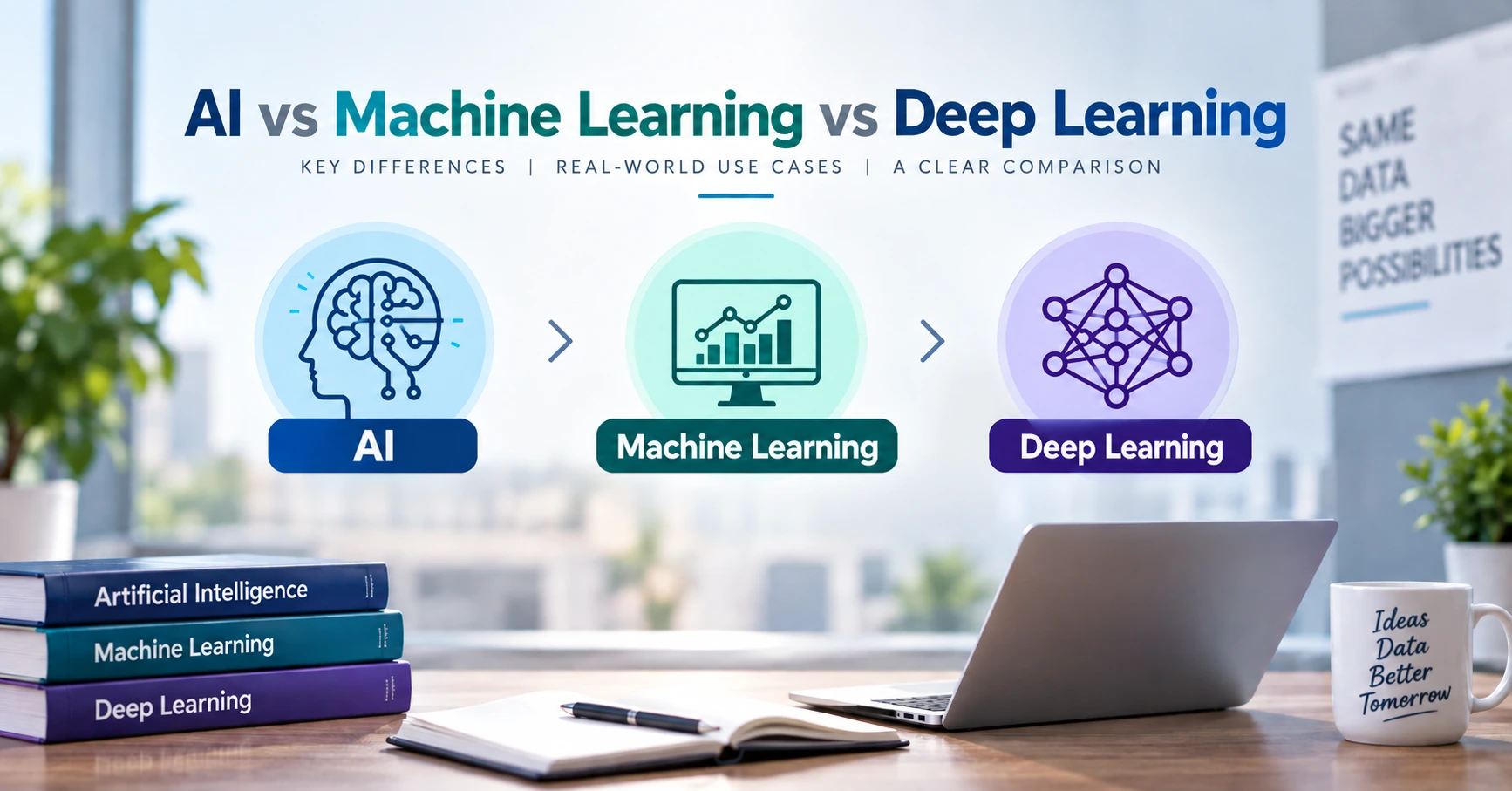
A simple way to remember it: all Deep Learning is Machine Learning, and all Machine Learning is AI - but not all AI involves Machine Learning, and not all Machine Learning involves Deep Learning.
Real-World Examples You Already Use
AI: Rule-based customer service bots that follow a fixed decision tree
Machine Learning: Netflix or Spotify recommending content based on your viewing or listening history
Deep Learning: Google Photos automatically recognising and grouping faces, or voice assistants like Alexa understanding spoken commands
Which One Should You Learn First?
If you're a student exploring a career in this space, the practical path is usually to start broad and go deeper: begin with the foundations of AI and programming, move into Machine Learning to understand how systems learn from data, and then specialise in Deep Learning once you're comfortable with the underlying statistics and neural network concepts. Trying to jump straight into Deep Learning without the ML fundamentals underneath it tends to make the learning curve unnecessarily steep.
Studying AI and Machine Learning at Medicaps University
At Medicaps University, this exact progression is built into how the B.Tech CSE - Artificial Intelligence and B.Tech CSE - Artificial Intelligence and Machine Learning programmes are structured. Students start with core programming and mathematical foundations before moving into machine learning algorithms, neural networks, and deep learning architectures - working hands-on with tools like TensorFlow, PyTorch, and Scikit-learn along the way.
For students who want to go further, Medicaps also offers an MCA specialisation in Artificial Intelligence and Data Science, extending the same foundation into applied, industry-facing projects. Rather than treating AI, ML, and Deep Learning as separate boxes to check, the curriculum is designed to show how each one builds on the last - which is exactly the relationship this blog has walked through.
FAQs
Is Machine Learning part of AI or separate from it?
Machine Learning is a subset of AI, not a separate field. All Machine Learning systems are a form of AI, but not all AI systems use Machine Learning.
Is Deep Learning better than Machine Learning?
Not necessarily "better" - Deep Learning is a specialised type of Machine Learning best suited to large, complex, unstructured datasets like images and audio. For simpler, smaller datasets, traditional Machine Learning methods are often faster and just as effective.
Do I need to learn Machine Learning before Deep Learning?
It's strongly recommended. Deep Learning builds on Machine Learning concepts like model training, overfitting, and evaluation - skipping straight to Deep Learning without this foundation makes the material significantly harder to grasp.
Which industries use AI, ML, and Deep Learning the most?
Healthcare, finance, e-commerce, manufacturing, and transportation are among the biggest adopters - using these technologies for diagnostics, fraud detection, personalisation, quality control, and autonomous systems respectively.
What is the best way to start a career in AI?
Building strong programming and mathematics fundamentals first, then progressively studying Machine Learning and Deep Learning through a structured programme - such as a B.Tech in Artificial Intelligence - combined with hands-on project work, is typically the most effective path.
 Back
Back


 About
About